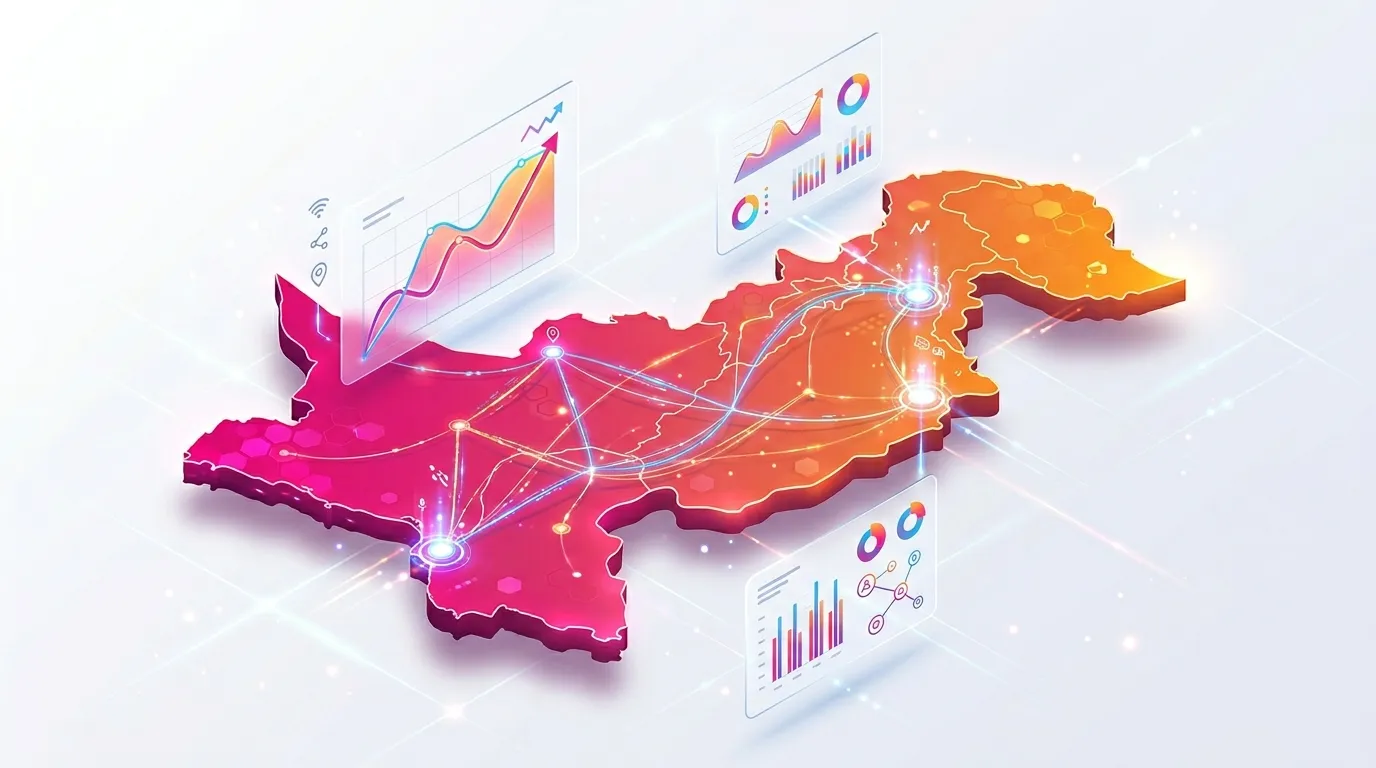
Pakistan is the world's fifth-most populous country with 240 million people, 135 million internet users, and a digital economy growing at 30% annually. It is the fastest-growing digital market in South Asia — and one of the last large-scale greenfield opportunities for global SaaS, fintech, and e-commerce companies. Despite its size, Pakistan remains dramatically underserved by global technology platforms, creating a rare window for first-movers to define entire categories.
“Pakistan has the population of Indonesia, the growth rate of India, and the competitive landscape of a market that global brands haven't touched yet. For companies entering now, the opportunity is generational.”
Pakistan by the Numbers: Key Market Statistics for 2026
- ●240 million people — 5th largest country by population, larger than Brazil and Russia
- ●135 million internet users — 55%+ penetration, with 85% accessing via mobile
- ●65% under age 30 — one of the youngest, most digital-native populations globally
- ●4 million+ freelancers — 4th largest freelancing population, active on Fiverr, Upwork, and Toptal
- ●30%+ digital economy growth rate — outpacing India, Indonesia, and Vietnam year-over-year
Why Global Brands Are Entering the Pakistan Market Now
Three misconceptions have historically kept global brands out of Pakistan — and all three are now outdated:
Misconception 1: “Pakistan is too small to matter.”
Pakistan has more people than Brazil, more internet users than Germany, and a digital economy larger than most of Southeast Asia. The market is not small — it has simply been underestimated.
Misconception 2: “Users don't pay for digital products.”
Mobile money accounts (JazzCash and Easypaisa) exceed 100 million. Platforms like Hostinger, Binance, and Spotify are seeing significant revenue growth from Pakistani users when pricing is localized in PKR and payment methods are adapted.
Misconception 3: “There's no distribution infrastructure.”
Pakistan has a thriving creator economy with thousands of YouTube channels, a massive freelancer network, and an affiliate marketing ecosystem that LIFT has built from the ground up. Distribution channels exist — they just require local expertise to activate.
→ See how Hostinger went from zero to #1 in Pakistan
Pakistan's Digital Growth Timeline
4G rollout accelerates. Internet users cross 70 million.
Pakistan enters top 5 globally on Fiverr and Upwork. SaaS adoption begins among tech workers.
COVID accelerates digital adoption by 3-5 years. E-commerce grows 200%. Digital payments spike.
Pakistan ranks 3rd globally in crypto adoption. LIFT begins operations, scaling Hostinger and Binance.
SaaS and edtech platforms see 3x user growth. Startup ecosystem raises $350M+ in venture funding.
Internet users cross 120 million. 5G trials begin. Government launches Digital Pakistan initiative.
JazzCash and Easypaisa reach 100M+ combined mobile money accounts.
Global platforms accelerate Pakistan entry. Market shifts from early-adopter to mass-market phase.
Which Sectors Are Growing Fastest in Pakistan?
- ●E-commerce & Retail: 300%+ growth since 2020. Market projected to reach $9B by 2027.
- ●Fintech & Crypto: 100M+ mobile money accounts. Crypto adoption among highest globally.
- ●EdTech & Online Learning: Explosive growth with 2M+ university students and rising online course adoption.
- ●SaaS & Developer Tools: 4M+ freelancers driving demand for Canva, Notion, Figma, and productivity tools.
- ●Gaming & Entertainment: 70M+ gamers. Mobile gaming revenue growing 40% YoY.
- ●Mobility & Logistics: Ride-hailing (Careem, InDrive, Bykea) and delivery apps expanding across 20+ cities.
→ Learn how affiliate marketing drives growth in each of these sectors
Pakistan vs Other Emerging Digital Markets
When compared to other large emerging markets, Pakistan stands out for one critical reason: it is the only market at this scale that remains genuinely greenfield for most global digital categories.
| Metric | Pakistan | Indonesia | Nigeria | Vietnam |
|---|---|---|---|---|
| Population | 240M | 275M | 220M | 100M |
| Internet Users | 135M | 200M+ | 110M+ | 80M+ |
| Market Status | Greenfield | Saturating | Competitive | Saturating |
| Competition | Low | Very High | High | High |
| First-Mover Advantage | Strong | Gone | Limited | Gone |
Indonesia, Nigeria, and Vietnam have all seen significant global platform entry in the last five years. Pakistan is the last remaining market at this scale where brands can still establish first-mover positioning across most digital categories.
How to Enter the Pakistan Market: The L.I.F.T. Framework
LIFT's proven four-phase framework has been used to scale 50+ global brands in Pakistan, from zero presence to category leadership:
Land
Enter Pakistan with precision. Establish local presence, localize pricing in PKR, adapt messaging for Pakistani audiences (bilingual Urdu + English), and integrate JazzCash/Easypaisa payments.
Integrate
Plug into the local ecosystem. Build affiliate networks, partner with tech YouTubers and influencers, connect with freelancer communities and university networks.
Fuel
Drive growth through high-impact campaigns. Launch creator collaborations, performance-based affiliate programs, and search demand generation to build momentum.
Takeover
Achieve category dominance. Scale the ecosystem, outpace competitors, and build a market presence that compounds over time.
Frequently Asked Questions
Yes. Pakistan has 240 million people, 135 million internet users, 4 million freelancers, and the fastest-growing digital economy in South Asia. SaaS tools like Canva, Notion, Hostinger, and Figma are seeing rapid organic adoption, and the market is still early-stage enough to offer significant first-mover advantage.
Pakistan's digital economy is growing at 30%+ annually. E-commerce alone is projected to reach $9 billion by 2027. With 135 million internet users and mobile internet penetration accelerating, the total addressable market is expanding faster than any other country in South Asia.
Key challenges include localization (Urdu + English bilingual strategy is essential), payment infrastructure (JazzCash and Easypaisa dominate over credit cards), pricing sensitivity (PKR-denominated pricing needed), and trust-building (Pakistani consumers rely heavily on influencer and community recommendations over traditional ads).
The most effective approach is the L.I.F.T. framework: Land (establish local presence and positioning), Integrate (connect with local payment systems, creators, and communities), Fuel (drive growth through affiliate and influencer campaigns), and Takeover (achieve category dominance). LIFT provides end-to-end support for each phase.