Payments & Integration · April 2026
JazzCash vs Easypaisa: Payment Integration for Global SaaS
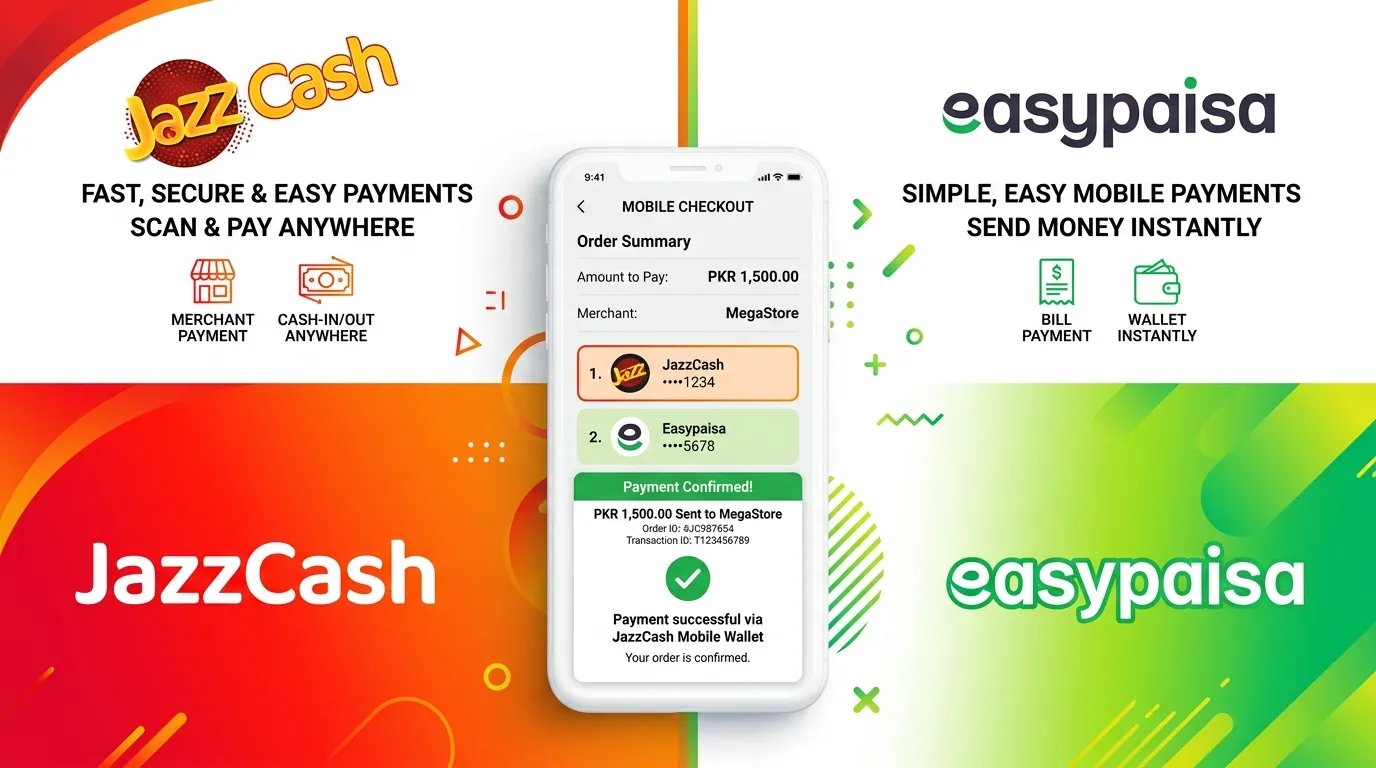
Pakistan's digital payment landscape is defined by two mobile wallets: JazzCash and Easypaisa. Together they serve over 70 million accounts and process the vast majority of digital transactions in a country where credit card penetration is below 5%. For any global SaaS, fintech, or e-commerce company entering Pakistan, integrating these payment methods is not optional — it is the single most impactful technical decision you will make.
Global SaaS companies that add JazzCash and Easypaisa as payment options typically see a 5–10x increase in Pakistan conversion rates compared to credit-card-only checkout flows.
Why Local Payment Integration Is Critical
Pakistan has over 135 million internet users, but fewer than 5% hold international credit cards. The overwhelming majority of digital transactions happen through mobile wallets, bank transfers, and cash-on-delivery. If your checkout only supports Visa, Mastercard, or PayPal, you are invisible to 95% of potential Pakistani customers.
This is not a minor optimization — it is a fundamental conversion blocker. LIFT has observed that brands adding local payment methods see conversion rates increase by 5–10x on their Pakistan landing pages. The pattern is consistent across SaaS subscriptions, app premium upgrades, and e-commerce purchases. Removing payment friction is the highest-leverage technical investment for Pakistan market entry.
JazzCash: Pakistan's Largest Mobile Wallet
JazzCash, operated by Jazz (Pakistan's largest mobile network with 80M+ subscribers), has over 40 million registered accounts. It is the dominant mobile wallet in urban Pakistan, particularly strong in Punjab and Sindh.
- User base: 40M+ registered accounts, 15M+ monthly active users.
- Strengths: Deep integration with Jazz's telecom network, strong merchant ecosystem, well-documented REST API, and support for recurring payments.
- API quality: JazzCash provides a modern REST API with sandbox testing, webhook notifications, and comprehensive documentation. Integration is straightforward for experienced teams.
- Merchant fees: 1.5–2.5% per transaction, depending on volume and contract terms.
- Settlement: T+1 to T+3 business days for merchant payouts.
Easypaisa: Broader Reach Across Pakistan
Easypaisa, operated by Telenor Microfinance Bank (backed by Telenor and Ant Group), has over 30 million registered accounts. Easypaisa has the widest agent network in Pakistan — over 170,000 retail agents — giving it stronger penetration in rural and semi-urban areas.
- User base: 30M+ registered accounts, 12M+ monthly active users.
- Strengths: Largest retail agent network (170K+ agents), strong rural reach, integration with Ant Group's technology stack, and growing mini-app ecosystem.
- API quality: Easypaisa's API has improved significantly since 2024. It supports payment requests, refunds, and status callbacks. Documentation is adequate but less polished than JazzCash.
- Merchant fees: 1.5–3.0% per transaction.
- Settlement: T+1 to T+3 business days.
JazzCash vs Easypaisa: Feature Comparison
| Feature | JazzCash | Easypaisa |
|---|---|---|
| Registered Accounts | 40M+ | 30M+ |
| Monthly Active Users | 15M+ | 12M+ |
| Urban vs Rural | Stronger in urban areas | Stronger in rural/semi-urban |
| Retail Agent Network | 100K+ agents | 170K+ agents |
| API Quality | Modern REST, well-documented | Adequate, improving |
| Recurring Payments | Supported | Limited support |
| Merchant Fees | 1.5–2.5% | 1.5–3.0% |
| Settlement Time | T+1 to T+3 | T+1 to T+3 |
Recommended Integration Architecture
Rather than integrating JazzCash and Easypaisa separately (which doubles your development, testing, and maintenance burden), LIFT recommends the payment aggregator approach. Pakistani payment aggregators like Safepay, Keenu, and the emerging Stripe Pakistan beta provide a single API that routes transactions to both wallets — plus debit cards, bank transfers, and other local methods.
- Single API integration covering JazzCash, Easypaisa, bank transfers, and cards.
- Unified merchant dashboard for reconciliation and reporting across all payment methods.
- Faster time to market: 1–2 weeks vs. 3–6 weeks for direct integration with each provider.
- Aggregator handles compliance, PCI DSS requirements, and regulatory updates — reducing your team's maintenance burden.
The aggregator adds a small fee (typically 0.5–1.0% on top of the underlying wallet fee), but the savings in engineering time, compliance overhead, and ongoing maintenance make it the clear choice for most global teams.
Practical Tips for Global Engineering Teams
- Display prices in PKR. Pakistani users expect to see prices in Pakistani Rupees. Use real-time exchange rates or set fixed PKR pricing tiers. Showing prices in USD creates friction and reduces trust.
- Support OTP-based authentication. Both JazzCash and Easypaisa use OTP (one-time password) for transaction authorization. Ensure your checkout flow handles the redirect-and-return pattern smoothly, with clear loading states and error handling.
- Implement webhook-based status tracking. Do not rely on synchronous payment responses. Use webhooks to track payment status (pending, completed, failed) and update your system accordingly.
- Test on low-bandwidth connections. Many Pakistani users access the internet on 3G or slow 4G. Optimize your checkout page weight, minimize JavaScript, and ensure the payment flow works on connections as slow as 1 Mbps.
- Provide Urdu-language payment instructions. Even users comfortable with English interfaces benefit from Urdu payment confirmation messages and error text. This reduces drop-off during the critical payment step.
Pakistan's Payment Infrastructure: What's Coming Next
Pakistan's payment ecosystem is evolving rapidly. The State Bank of Pakistan's Raast instant payment system — Pakistan's equivalent of India's UPI — is expanding from person-to-person transfers to merchant payments. Raast promises near-zero transaction fees and instant settlement, which will transform the cost structure for digital payments in Pakistan.
Additionally, Pakistan's central bank is developing a regulatory framework for digital-only banks (neobanks), and several players are expected to launch by late 2026. For global SaaS companies, the key takeaway is that payment infrastructure in Pakistan is improving quickly — but JazzCash and Easypaisa will remain the dominant consumer payment methods for the next 2–3 years.
Related Articles
Frequently Asked Questions
Yes, if you want maximum coverage. JazzCash and Easypaisa together account for over 85% of mobile wallet transactions in Pakistan. Using a payment aggregator like Safepay, Stripe (Pakistan beta), or Keenu lets you support both wallets — plus bank transfers and cards — through a single API integration.
Using an aggregator, a technical team can complete integration in 1–2 weeks. Direct integration with JazzCash or Easypaisa APIs takes 3–6 weeks due to merchant onboarding, compliance documentation, and testing requirements. LIFT recommends the aggregator approach for speed and simplicity.
JazzCash merchant fees range from 1.5–2.5% per transaction. Easypaisa charges 1.5–3.0% depending on transaction type and volume. Both platforms charge lower fees for higher-volume merchants. Aggregators add a small markup (typically 0.5–1.0%) but save significant engineering and compliance overhead.